
Stacker, Ship Loader, Eco Hopper, Reclaimer, Truck Unloader, Belt Conveyor Manufacturer

At SKE Industries, we provide industry-leading bulk material handling equipment designed to optimize efficiency in mining, quarrying, ports, aggregate and more industries. Explore our range of belt conveyors, mobile stacker conveyors, ship loaders, mobile hoppers and more equipment engineered for handling bulk materials. Our bulk material handling solutions cover feeding, reclaiming, conveying, loading & unloading, stacking, and more.
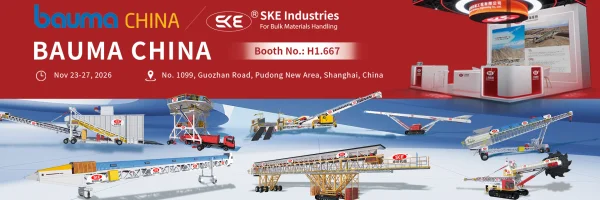

We provide tracked stacker, radial telescopic stacker, tracked radial stacker and hopper feeder stacker for stcokpiling bulk materials in quarrying, mining, port and more industries. They can be used in stacking aggregate, coal, ores, wood chips, sand, top soils, etc.

Our range of port handling equipment ensures unrivaled flexibility when loading dry bulk materials onto vessels. You can get tracked radial telescopic shiploader, all wheel travel ship loader, rail-mounted ship loader and Cambered Boom Ship Loader, and more.

The mobile conveyors are not only able to be used in transferring bulk materials but also can be used in stacking bulk materials. The tracked conveyors, tracked radial conveyors, radial telescopic conveyors, grasshopper conveyors, horizontal bridge conveyors are the common types of mobile conveyors.

Our bulk surface feeders can work as truck unloader for unloading bulk materials from dumper and ADT truck. They can take surge impact of bulk materials falling from trucks. We provide tracked type, wheeled type and fixed type bulk surface feeder.

Our range of mobile hopper feeder ensures unrivaled flexibility when reclaiming, feeding, unloading, and loading. You can get tracked hopper feeder, and low feeder range hopper feeder stacker.

The Mobile Port Hopper is a device commonly used at port and dockside locations for receiving materials from grab ship unloader to unload ships. It is a port based machine, a close substitute to Grab Ship Unloader.

Our range of tracked mobile bucket wheel reclaimer can be used to reclaim bulk materials from stockyard to feed conveyors, trains, wagons, trucks, etc. We offer 500m³/h model, 1000m³/h model,2000m³/h model and 2800m³/h model.

We provide universal belt conveyors including overland conveyor, crushing plant conveyor, and pipe belt conveyor, and sidewall belt conveyor. We will provide customers customized belt conveyor for bulk material handling systems.

You can use our belt tripper conveyor to store bulk materials in open-pit, flat warehouse, bins, bunker, silo, etc. Depending on the height of the pillars, tripper conveyors are capable of large quantity stockpiles. We offer tripper system, tripper car, shuttle conveyor and plough discharger.

Bucket elevators, also called a grain leg, are a critical component in various industries for the efficient vertical transport of bulk materials. We provide GTD belt type, NE plate chain type and GTH round link type bucket elevator conveyor.
Bulk material handling equipment refers to machines and systems used to transport, store, control, and manage bulk materials such as ores, coal, grains, sand, gravel, and other loose materials. These systems are essential in industries like mining, agriculture, construction, manufacturing, and energy. SKE Industries offers advanced bulk material handling equipment, and we can supply all of the following machines :
Crushers are essential equipment in bulk material processing, used to reduce the size of raw materials such as ores, coal, rocks, and aggregates. They are widely used in industries like mining, construction, recycling, and cement production. We provide:
Belt conveyors are the backbone of most bulk material handling systems, offering continuous material transport over both short and long distances. We provide:
Feeding equipment is used to regulate and control the flow of bulk materials into processing systems.
These machines are used for stockpiling materials and then reclaiming them when needed. Stackers: Build large piles of materials in storage yards or warehouses. We have stackers:
Our reclaimer can automatically retrieve bulk materials from stockpiles for further processing or transport. We have:
In ports and terminals, ship loading equipment are large machines that load materials onto ships in an efficient, continuous manner. We provide:
Bulk material handling equipment refers to machines and systems used to receive, transport, feed, stack, reclaim, load, and unload loose materials in bulk quantities. Common equipment includes belt conveyors, mobile stackers, hopper feeders, ship loaders, ship unloaders, truck unloaders, and bucket wheel reclaimers.
Bulk material handling equipment is widely used in ports and terminals, mining, quarrying, aggregate processing, cement plants, power stations, steel plants, grain terminals, agriculture, recycling, and construction materials industries. Equipment configurations vary according to material characteristics and production requirements.
A complete bulk material handling system may include receiving hoppers, truck unloaders, feeders, belt conveyors, transfer conveyors, stackers, storage facilities, reclaimers, and ship loading or unloading equipment.
Depending on the equipment design, bulk handling systems can process:
Material density, particle size, moisture content, abrasiveness, and flowability should be considered when selecting equipment.
Fixed equipment is permanently installed and is suitable for continuous operations with established material flow routes. Mobile equipment can be repositioned between different working areas, stockpiles, or loading points.
Mobile systems offer greater flexibility and can reduce the need for permanent infrastructure and extensive civil construction, depending on the project layout.
Equipment selection should consider the following factors:
Providing these details helps engineers recommend suitable equipment configurations.
Required capacity is generally determined by the production target, material flow rate, operating hours, and peak loading conditions. The design should also consider bulk density, material characteristics, equipment availability, and potential bottlenecks.
For an integrated system, the capacities of feeders, conveyors, stackers, and downstream equipment must be properly matched to maintain the required material flow.
Port bulk material handling systems commonly use mobile ship loaders, ship unloaders, mobile hoppers, Eco Hoppers, transfer conveyors, and truck or railcar loading and unloading equipment.
For example, a ship unloading system may combine a grab ship unloader, receiving hopper, feeder, and belt conveyor. A ship loading system may use transfer conveyors and a mobile ship loader to deliver cargo into vessel holds.
Overland belt conveyors are commonly used for long-distance bulk material transportation. Pipe belt conveyors can provide enclosed conveying along routes with curves and environmental constraints. Sidewall belt conveyors are suitable for steep-angle conveying where conventional troughed belts may require more space.
The final selection depends on conveying distance, elevation changes, terrain, material properties, capacity, and environmental requirements.
Dust and spillage can be controlled through properly designed transfer chutes, enclosed belt conveyors, conveyor covers, belt skirting, dust extraction systems, and dust suppression equipment.
For port operations, Eco Hoppers and enclosed material transfer systems can help reduce dust emissions during ship unloading. The appropriate solution depends on cargo characteristics and local environmental requirements.
Yes. Bulk material handling equipment can be customized according to required capacity, material characteristics, conveying distance, discharge height, site conditions, mobility, power supply, and automation requirements.
SKE Industries can provide equipment configurations for specific applications, including ports, mining operations, quarries, stockyards, and industrial material handling plants.
SKE Industries manufactures a range of bulk material handling equipment covering conveying, feeding, stacking, reclaiming, loading, and unloading operations. Multiple machines can be integrated into a project-specific system according to the required material flow and technical specifications.
The engineering and supply scope should be confirmed according to individual project requirements.
We have gained deep knowledge in the research, design and manufacturing of conveyor equipment for bulk material handling over the past decade. We have supplied numerous conveyor systems to our customers.
We have a large-scale conveyor machine manufacturing base in Shanghai, China, with a floor space of over 60,000㎡. We have the ability to undertake projects of any scale.
Our bulk material handling equipment is highly standardized. We have ample supply of spare parts. The entire structure is designed for easy maintenance. You only need to perform routine maintenance to keep the machine running stably.